
Asset Recovery Is a Location System Problem, Not a Tag Problem
Most asset recovery conversations start with the object: a tag, a tracker, a device, a battery spec, a mounting option. That framing is comfortable because it makes recovery feel like a purchasing decision. In practice, asset recovery is not a device problem. It’s a location system problem.
Juxta
Juxta Team
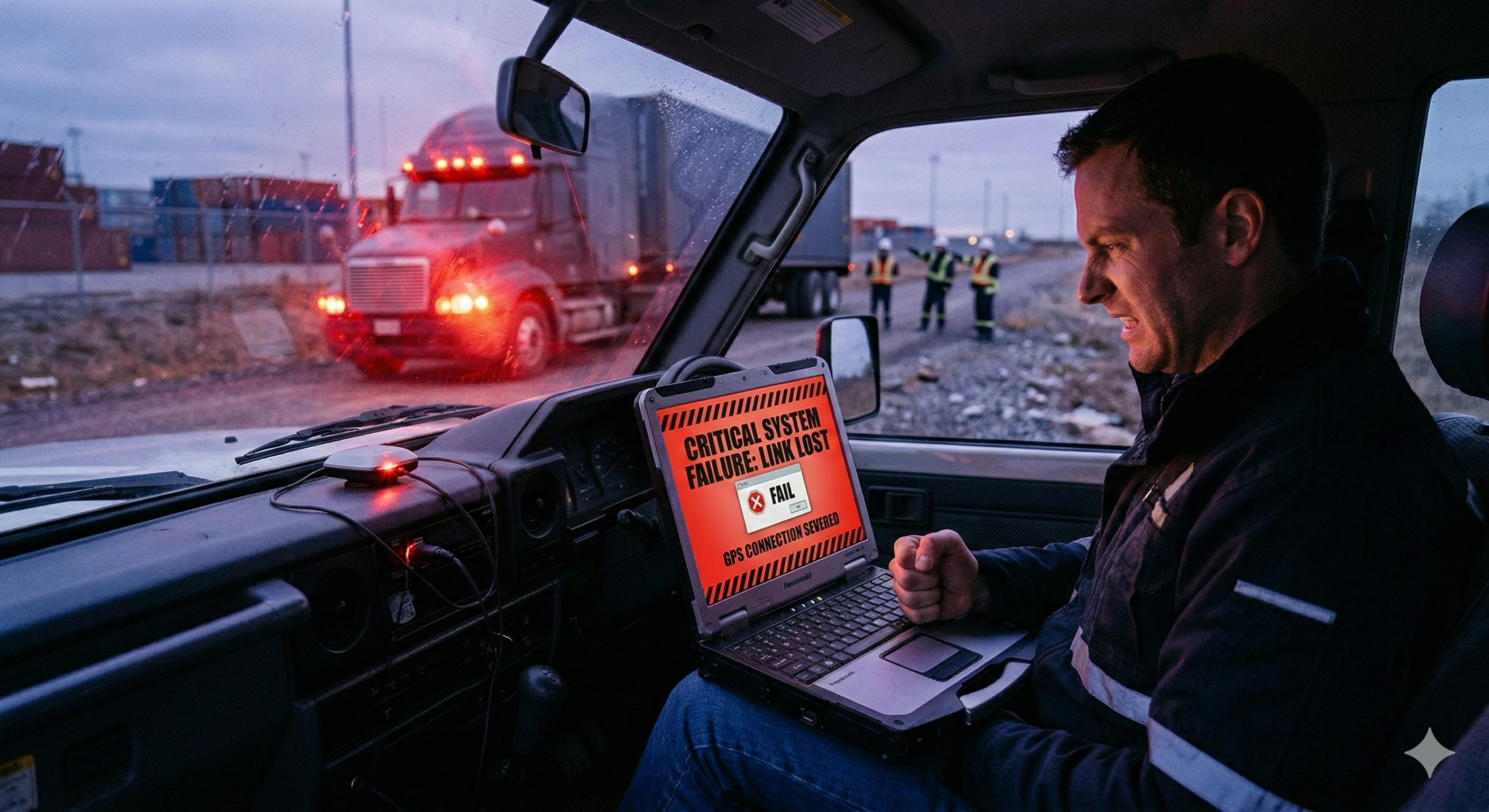
The Recovery Gap: Detected does not mean Recoverable
Teams usually discover this gap the hard way.
A system reports that an asset is “near a site.” The map looks authoritative. The timestamp appears recent. Then the search begins, and the search becomes a workflow: calls, yard walks, gate checks, manual verification, and escalating time loss.
That’s the moment you learn what the tracking system is actually optimized for. Many systems optimize for events: pings, sightings, check-ins. Recovery is optimized for resolution: a credible, actionable location that a team can physically execute against.
Recovery requires a higher standard than “we saw it.”
Why tag-centered strategies break down
Tags can be useful. The failure is not the existence of tags; it’s the belief that tags alone create a recovery system.
Tag-centered strategies usually inherit one or more dependency models that are fragile at scale:
They depend on consistent network conditions.
In real operations, connectivity is intermittent in yards, terminals, basements, industrial corridors, and rural edges.
They depend on density to create certainty.
A system that becomes reliable only when enough receivers, gateways, phones, or readers are nearby turns recovery into a probabilistic game. The worst losses often happen in the sparse zones.
They depend on the environment behaving.
Metal structures, stacked equipment, occlusions, and indoor/outdoor transitions create ambiguity that “more tags” does not fix.
They depend on humans to close the loop.
If a “hit” still requires phone calls and searching, you don’t have a recovery system. You have a hint engine.
When the dependency model is wrong, you can add more devices indefinitely and still fail to retrieve what matters.
What recovery-grade tracking actually means
A recovery-grade system must do three things consistently:
It must maintain continuity, not just sightings.
Recovery is about understanding movement and state, not just last-known pings. Continuity reduces search area, reduces doubt, and reduces time-to-retrieval.
It must express confidence, not just coordinates.
A map that always looks certain is dangerous. Recovery teams need to know whether they’re acting on a precise truth or an approximate guess.
It must reduce operational burden.
If recovery creates manual work at the worst possible moment, it will be deprioritized, delayed, or skipped. Systems that win reduce steps, not add them.
This is why the right question isn’t “how small is the tag?” It’s “how fast can we retrieve the asset when conditions are hostile?”
Universal Positioning System (UPS): making recovery infrastructure-free
UPS matters for asset recovery because recovery rarely happens in ideal conditions. Assets disappear into boundary zones: indoor/outdoor transitions, dense industrial layouts, low-connectivity areas, and places where infrastructure is expensive or operationally unrealistic to deploy.
Juxta defines a Universal Positioning System (UPS) as a positioning substrate that provides usable coordinates across environments without requiring fixed infrastructure to be installed, calibrated, and maintained at every site.
UPS reframes recovery as a system property:
- Not a device feature
- Not a coverage gamble
- Not a site-by-site infrastructure project
Instead, it treats recovery as a continuity problem: maintain location truth across environments so retrieval becomes execution, not investigation.
The executive metric that matters: time-to-retrieval
Asset recovery strategies are often evaluated on device metrics: battery life, size, durability, cost per unit. Those are procurement metrics.
The operational metric that matters is simpler:
How long does it take to retrieve the asset once it matters?
Time-to-retrieval includes all the hidden friction:
- The time spent validating whether the data is credible
- The time spent coordinating access (gates, yards, facilities)
- The time spent physically searching because “near here” isn’t enough
- The time spent escalating when the first attempt fails
If your system can’t reliably compress time-to-retrieval, it is not an asset recovery system. It is a visibility system with recovery as a marketing claim.
A buyer’s recovery checklist
If you’re evaluating vendors or redesigning your recovery posture, these questions expose whether you’re buying recovery or buying signals.
1) What happens in low-connectivity zones?
If performance collapses when connectivity weakens, your worst losses will be your least recoverable.
2) How does the system handle indoor/outdoor transitions?
Many assets disappear at the edges. If the system can’t track across those edges without special infrastructure, it won’t recover the assets that cost you the most.
3) Does it reduce search work or merely redirect it?
A “last seen near…” is not recovery. Recovery is fewer steps, fewer calls, fewer walks, and fewer dead ends.
4) Can the system explain the asset’s movement with integrity?
Recovery often becomes a dispute: theft, misplacement, process failure. A system that cannot reconstruct movement reliably cannot support accountability.
5) Can you scale without turning every site into a project?
If every recovery improvement requires new hardware deployments, your recovery program will stall before it becomes comprehensive.
The new posture: stop buying hints, start buying truth
Asset recovery will always involve operational complexity. But it does not have to involve operational guesswork.
The next era of tracking will separate systems that generate sightings from systems that deliver recovery-grade truth. A tag can be part of the story. It is not the story.
Recovery is a location system problem. When you solve the location system—when you have infrastructure-free continuity, confidence-aware positioning, and a substrate designed for hostile environments—asset recovery stops being an aspiration and becomes a capability.
That’s what UPS is built to deliver.