
Fleet Tracking Without Cellular Dependency
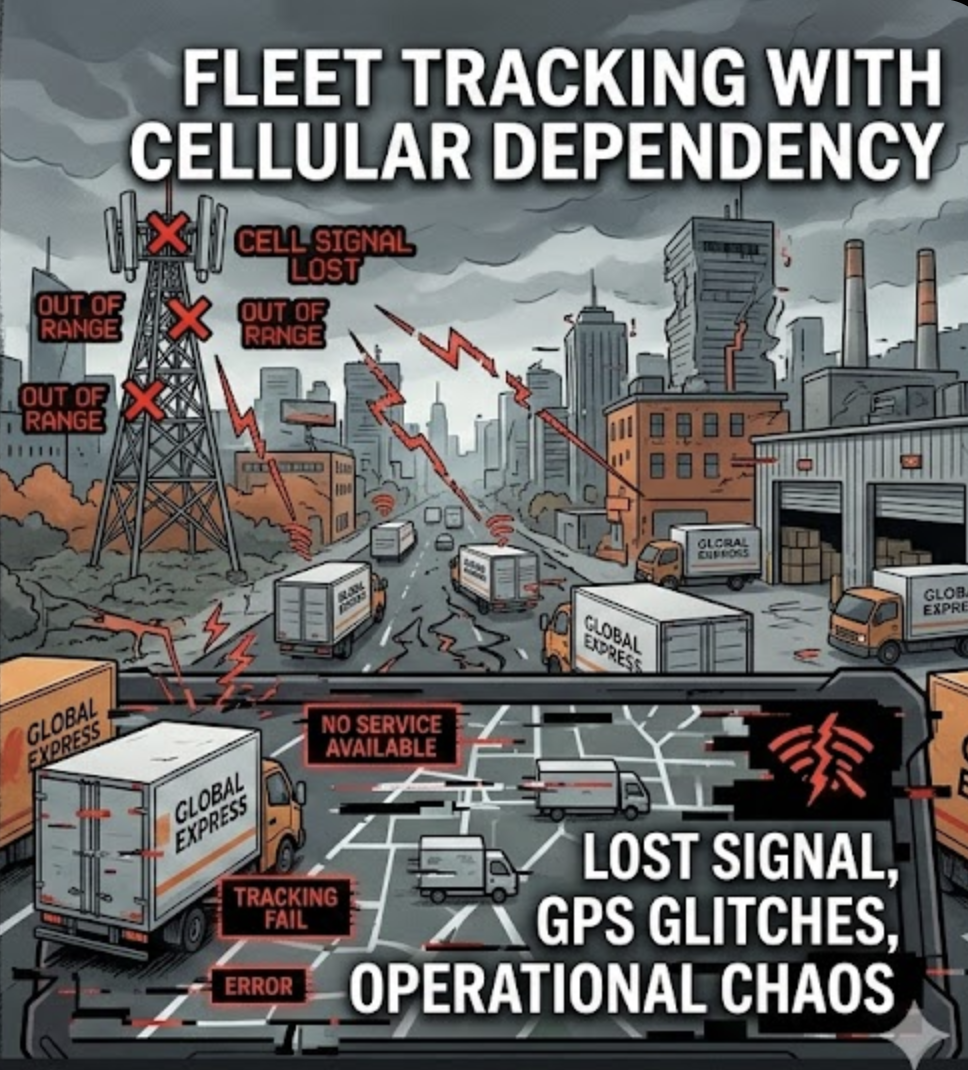
For two decades, fleet tracking has meant one thing: GPS device → cellular transmission → cloud dashboard. This model works — until it doesn’t. When fleets move through indoor depots, underground facilities, rural dead zones, high-security environments, or RF-constrained regions, cellular-dependent tracking begins to fracture. The assumption that visibility requires connectivity is now being challenged. Fleet tracking without cellular dependency is no longer theoretical. It is architectural.
Juxta
Juxta Team
Why Cellular Became the Default
Telematics systems were built around three pillars:
- GPS for position
- Cellular networks for transmission
- Cloud platforms for visualization
Cellular provided the bridge between the asset and the operations center. As long as signal was available, fleets could monitor movement in real time.
But this created a structural dependency:
No signal → no visibility.
The architecture never removed that constraint. It optimized around it.
Where Cellular Dependency Breaks Down
Fleet operations are not purely highway-based.
Vehicles and assets move through environments where cellular reliability is inconsistent or nonexistent:
- Indoor warehouses and distribution centers
- Covered loading docks
- Underground parking or storage
- Mining and energy sites
- Remote industrial regions
- Military or RF-denied environments
Even in urban environments, signal degradation and multipath interference introduce positioning instability.
Cellular-based tracking assumes the world is always connected.
Fleet operations prove otherwise.
The Risk of RF-Dependent Architectures
Cellular-based systems are not just fragile in low-signal areas. They are structurally exposed.
They rely on:
- Radio frequency transmission
- External carrier infrastructure
- Cloud routing layers
- Public network surfaces
This introduces:
- Jamming vulnerability
- Spoofing exposure
- Detectability
- Data interception risk
- Latency variability
For commercial fleets, this is operational friction.
For defense, government, and high-security logistics, it is unacceptable risk.
The more critical the operation, the less acceptable external network dependency becomes.
The Misconception: “Offline” Means “Delayed Sync”
Some systems advertise offline capability.
But in most telematics architectures, offline simply means:
Store data locally → sync later when signal returns.
That is not true independence.
That is temporary buffering.
True cellular independence means:
Positioning continues in real time without any network dependency.
Not cached.
Not deferred.
Not waiting for reconnection.
Fully operational.
The Architectural Shift: On-Device Positioning
Fleet tracking without cellular dependency requires a fundamental inversion of architecture.
Instead of:
Device → Network → Cloud → Position
The model becomes:
Device → Position (locally)
Modern positioning systems can:
- Use inertial measurement unit (IMU) sensors already embedded in devices
- Map environments through polygonized spatial models
- Generate synthetic IMU data to train transformer-based accuracy engines
- Execute inference entirely on-device
- Minimize drift over extended operational periods
In this model, connectivity becomes optional — not foundational.
What True Cellular Independence Enables
When fleet tracking operates without cellular dependency, several strategic advantages emerge.
1. Continuous Indoor Visibility
No handoff between systems when vehicles enter warehouses, garages, or covered areas.
Tracking remains unified across:
Indoor
Outdoor
Underground
Without switching technologies.
2. Operational Resilience
In remote regions or disaster scenarios:
- No reliance on carrier coverage
- No waiting for signal restoration
- No data blind spots during outages
Operations continue without interruption.
3. Security by Design
When positioning:
- Does not emit RF signals
- Does not depend on public networks
- Can operate air-gapped
- Executes locally
It becomes inherently more secure.
In high-threat environments, this distinction is decisive.
4. Infrastructure Elimination
Removing cellular dependency removes:
- SIM management
- Carrier contracts
- Roaming fees
- Bandwidth scaling costs
- Connectivity troubleshooting
Scaling becomes computational, not network-based.
The Economics of Removing Cellular from the Equation
Cellular dependency compounds with scale.
More vehicles mean:
- More data plans
- More bandwidth
- More carrier exposure
- More operational overhead
Eliminating that layer flattens scaling costs.
Instead of paying per-device network overhead, fleets deploy models.
Expanding into new regions does not require negotiating with carriers.
Entering signal-denied facilities does not require infrastructure installation.
Connectivity becomes a synchronization tool — not a positioning requirement.
The Future: Universal Positioning Without Infrastructure
Fleet intelligence is evolving from network-dependent tracking to infrastructure-free positioning.
The next generation of fleet systems will:
- Operate without GPS reliance
- Function without cellular dependency
- Deliver indoor and outdoor continuity
- Execute on-device inference
- Minimize drift through advanced model training
- Deploy through software rather than hardware rollouts
This is not incremental improvement.
It is architectural replacement.
The Question for Fleet Leaders
As fleets grow more complex, more automated, and more security-sensitive, the key question becomes:
Is your visibility dependent on someone else’s network?
If the answer is yes, your operations inherit the fragility of that network.
The fleets that lead the next decade will not simply optimize connectivity.
They will remove dependency on it.