QuaterNet: Advanced AI for Human Motion Prediction
QuaterNet changes how we teach the model to predict motion. Instead of measuring whether the machine’s internal joint settings match a target, it measures whether hands, feet, head — the things users care about — land where they should. The outcome is a noticeably better short-term predictions and long-range motion that people judge as just as natural as the latest neural approaches.
Juxta
Juxta Team
The Challenge
Traditional approaches to human motion prediction face critical limitations that impact production quality and computational efficiency:
- Rotation-based methods suffer from error accumulation and mathematical instabilities (gimbal lock), leading to unrealistic motion artifacts
- Position-based methods require expensive post-processing to maintain anatomical constraints, increasing computational costs and introducing visual discontinuities
- Existing solutions struggle to balance short-term accuracy with long-term motion realism
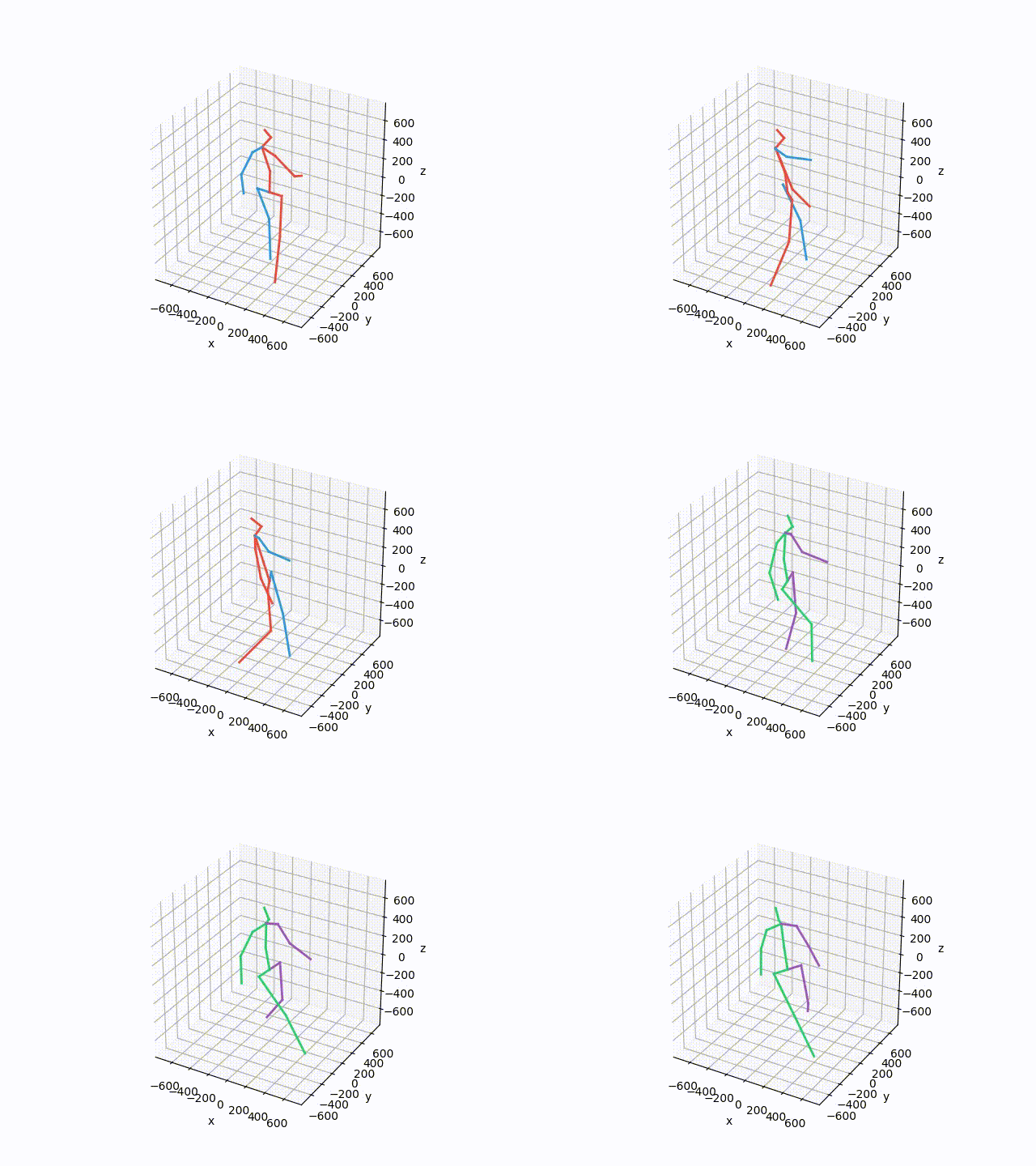
QuaterNet represents a significant advancement in predicting and generating realistic 3D human motion sequences—a capability with immediate applications in animation, gaming, virtual reality, action recognition, and computer vision systems.
QuaterNet's Competitive Advantages
Quaternet employs Gated Recurrent Units which takes a temporal sequence rotations corresponding to poses and predict next pose in an auto regressive manner.
1. Quaternion-Based Architecture - Pose Representation
Quaternions, a mathematically robust 4-parameter representation, eliminates discontinuities and singularities that plague traditional 3-parameter rotation systems (Euler angles, exponential maps).
This provides:
- Numerical stability throughout the kinematic chain
- Efficient GPU computation with only 20% overhead
- Seamless integration with recurrent neural networks
2. Forward Kinematics Loss Function
Differentiable loss function enforces skeletal constraints during training, not as an expensive post-processing step, by:
- Computing joint positions directly from predicted rotations
- Penalizing errors in absolute 3D positions rather than abstract angles
- Eliminating bone-stretching artifacts and re-projection costs
Proven Performance Metrics
Short-term prediction: QuaterNet achieves state-of-the-art quantitative results on the Human3.6M benchmark, the industry-standard dataset for motion prediction evaluation.
Long-term generation: Human evaluators rate QuaterNet's generated motion as realistic to leading computer graphics methods, while offering:
- Real-time online generation capability
- Precise control over timing, trajectory, and gait parameters
- Scalability to extended motion sequences
Scalability & Integration
QuaterNet's efficient design enables:
- GPU-accelerated batch processing for production pipelines
- Real-time inference for interactive applications
- Flexible control interfaces for artist-driven or automated workflows
- Easy integration with existing animation and computer vision systems
Applications & Market Opportunities
- Film & Gaming: Reduce animation costs by generating realistic character motion from minimal control inputs
- Virtual Reality: Enable responsive, natural avatar movement in real-time interactive environments
- Computer Vision: Improve action recognition and human activity prediction systems
- Sports Analytics: Model and predict athlete movements for training and performance optimization
- Healthcare: Analyze gait patterns and predict patient mobility for rehabilitation planning
Conclusion
QuaterNet, a quaternion-based recurrent model for human motion addresses two longstanding issues:
- Using quaternions to avoid the discontinuities and singularities of common angle formats.
- Training with a forward-kinematics positional loss to respect skeleton constraints while optimizing what viewers perceive.
This generation is real-time to offer tighter control over timing & space.
Integrity note: This post reviews and references publicly available work from third-party authors.