
RTLS: Why Position Continuity Beats Infrastructure-Led Tracking
For years, the market has asked the same first question about positioning: Which RTLS technology should we deploy? UWB, BLE, RFID, Wi-Fi, hybrids, tags, anchors, readers, gateways, dashboards, integrations. The category has trained buyers to think of location as a procurement exercise: pick a stack, install it, calibrate the site, connect the data, and then extract operational value. That model still dominates most RTLS education content today. But that framing is starting to break. Not because location stopped mattering. Quite the opposite. Location has become more operationally central than ever. Warehouses need real-time movement truth. Industrial sites need resilience in covered and degraded environments. Underground teams need continuity where satellites and conventional infrastructure fail. Fleets need visibility that does not disappear the moment conditions change. Juxta’s recent blog coverage has emphasized exactly that shift: the market is moving away from bulky infrastructure and signal dependence toward infrastructure-free positioning that can survive harsher, more variable operating conditions. The real question is no longer which RTLS stack to buy. The real question is why positioning is still being sold as an infrastructure project.
Juxta
Juxta Team
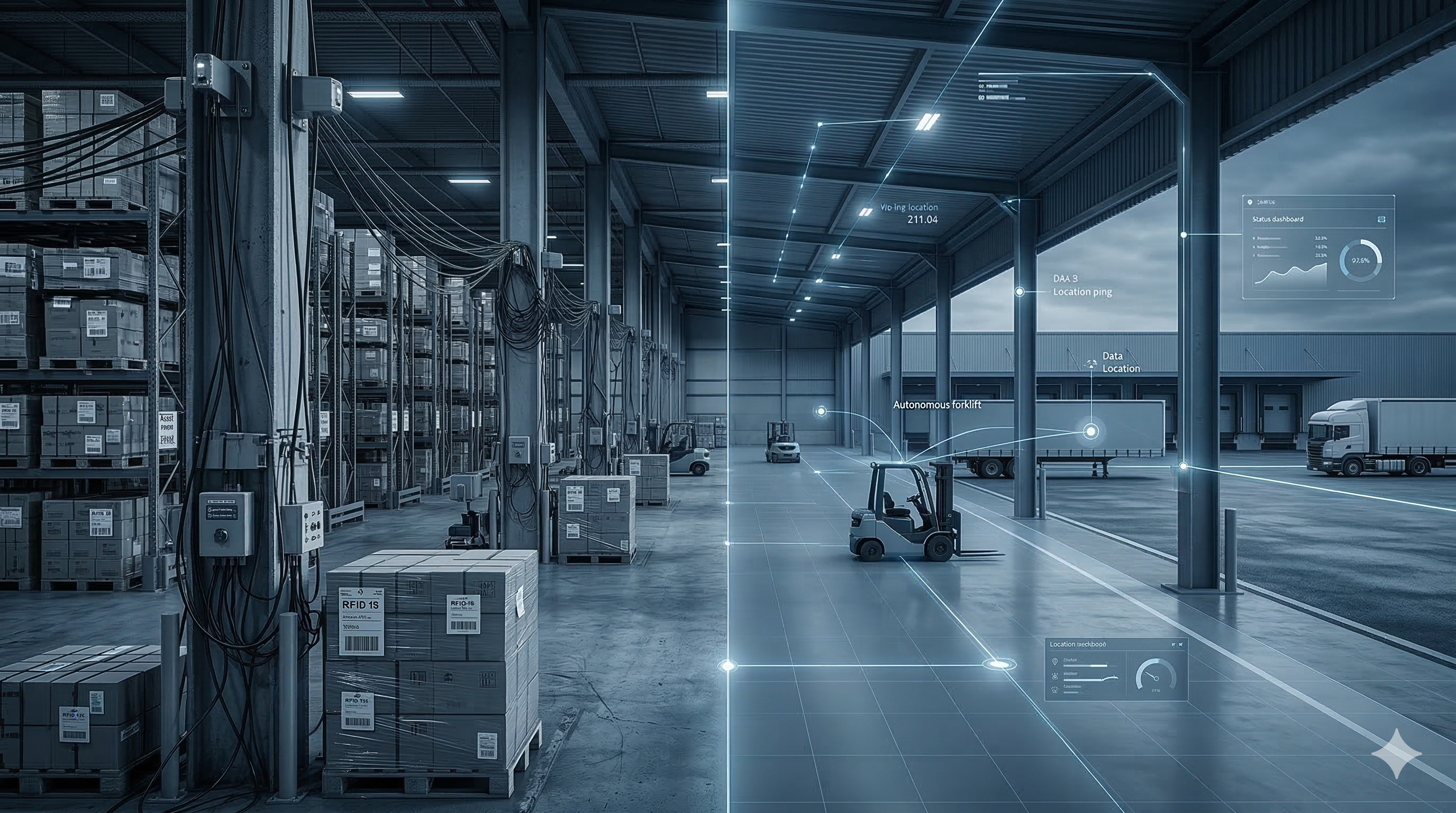
RTLS solved an important problem, then froze the architecture
RTLS became valuable because it addressed a real gap. GPS works poorly or not at all indoors, underground, and in many covered environments. Enterprises needed a way to locate people, tools, pallets, vehicles, and equipment where satellite-based positioning could not deliver reliable results. That need gave rise to the standard RTLS playbook: tagged objects, installed readers or anchors, a central location engine, and workflow software on top. The category still presents this model as the default way to achieve indoor accuracy and operational awareness.
That was a meaningful step forward.
But the market made a subtle mistake. It accepted the deployment model as if it were inseparable from the outcome.
In other words, buyers started treating installed infrastructure as the natural price of position truth.
That assumption now creates more friction than many operators can justify.
The hidden cost is not the hardware bill. It is the deployment burden.
Most location systems do not fail in the slide deck. They fail in rollout.
The technical comparison usually gets all the attention: accuracy ranges, latency, battery life, radio behavior, update intervals, tag form factors, API support. Those questions matter. But they distract from the harder business issue: the burden of converting visibility into a site program.
The standard RTLS approach usually requires some combination of hardware sourcing, on-site installation, layout planning, calibration, maintenance, staff training, and system integration. Even category-level explainers position deployment this way, with implementation, hardware, and workflow integration treated as expected steps on the road to ROI.
That may be manageable in a tightly controlled facility with stable conditions and a clear budget owner.
It becomes much harder across distributed environments, live industrial sites, changing warehouse footprints, underground operations, mixed indoor–outdoor transitions, or facilities where downtime, site access, and maintenance windows are constrained. Juxta’s recent writing on hardware-based fleet systems and hardware tracking makes the same broader point from adjacent markets: infrastructure burden compounds over time financially, operationally, and strategically.
This is where many location projects quietly shift from “precision system” to “deployment program.”
And that is exactly the problem.
Operations do not happen in clean indoor boxes
A large share of RTLS content still treats the operating world as a set of bounded environments. Indoors here. Outdoors there. Infrastructure installed where needed. Coordinate systems cleanly defined. Assets moving in a contained footprint.
Real operations are not that tidy.
A forklift moves from yard to dock to covered lane to warehouse floor. A trailer sits in a terminal zone where visibility degrades under roofing and interference. A mining crew works below grade where conventional signals break down. A utility or industrial team moves through spaces where connectivity is intermittent and fixed infrastructure is difficult to install or maintain. Juxta’s own recent inventory keeps returning to these same operating seams: underground environments, harsh logistics conditions, and mixed zones where conventional systems become fragile or too expensive to scale cleanly.
The issue is not simply whether a system works indoors.
The issue is whether location continuity survives boundary conditions.
That is where the old category starts to show its limits.
“Hybrid” is often a symptom, not a solution
As the cracks in the legacy model widen, the market’s answer is often to layer more systems together.
More integration.
More signal sources.
More handoffs.
More hybrids.
At first glance, this sounds like progress. And in some cases it is a practical response. But strategically, it often reveals that the architecture is compensating for fragmentation rather than removing dependence. Even recent RTLS platform updates position hybrid support and data integration as major advances, which is useful from a product perspective but also telling: when visibility depends on stitching together multiple external inputs, integration complexity becomes part of the operating model.
That creates a different kind of risk.
Instead of asking whether one technology is accurate enough, operators end up managing whether the full chain remains intact:
signal availability, infrastructure uptime, device maintenance, calibration quality, data fusion logic, network reliability, and application-layer integration.
A system can look technically sophisticated while still increasing operational exposure.
The next category is not “better RTLS.” It is position continuity.
This is the shift Juxta is positioned to define.
The future category is not a slightly more efficient hardware stack. It is not a nicer dashboard layered on top of tags and anchors. It is not just another procurement decision inside the RTLS menu.
It is a different architecture for position truth.
One that starts with infrastructure-free deployment, uses polygonization to understand operating context, relies on synthetic IMU generation and accuracy engines rather than site-installed dependency, focuses on drift minimization as an operational requirement, not a hidden technical footnote & keeps inference on-device so position truth is available where conditions are weakest, not only where systems are best connected.
That is a fundamentally different view of the problem.
It treats location as an always-on operational layer rather than a hardware project that must be installed into every environment before it becomes useful.
Why this matters to operators
Operators do not buy positioning for its own sake.
They buy it to reduce search time.
To lower exception rates.
To improve safety response.
To recover assets faster.
To reduce blind spots in high-friction workflows.
To keep operations moving when conditions degrade.
To avoid turning every deployment into a facility retrofit.
That is why the category has to evolve.
If a location system delivers impressive accuracy in carefully prepared zones but slows rollout, raises maintenance burden, or struggles at the boundaries where operations actually break, then the business case weakens fast.
Position truth is only valuable when it is durable.
Not in the perfect room.
In the real workflow.
A better evaluation framework for 2026
Enterprises evaluating positioning systems should stop asking only which RTLS technology performs best in ideal conditions.
A better set of questions looks like this:
Can this deploy without site-wide infrastructure work?
Can it maintain continuity across mixed indoor–outdoor and degraded environments?
Does it reduce dependency exposure, or just redistribute it across more components?
Will it scale operationally across facilities, yards, terminals, industrial zones, and underground conditions without becoming a maintenance program?
Does it produce defensible location truth where conventional systems are weakest?
These are not niche questions anymore. They are quickly becoming the questions that separate a successful pilot from a scalable operating layer.
The category is shifting whether the market admits it or not
RTLS will remain an important part of the positioning market. It solved real problems and still has strong use cases. But the category assumptions that built RTLS are no longer enough for the environments that matter most.
The market does not need one more explainer on anchors versus tags.
It needs a new standard for what buyers should expect from location itself.
Not hardware-first deployment.
Not signal dependence.
Not integration-heavy compensation.
Not visibility that fades at the edges.
The next category is position continuity without infrastructure burden.
That is not just a product improvement.
It is a replacement for the way the market has been taught to think.