
The Feature Trap: Why Telematics “Innovation” Keeps Increasing Fleet Overhead
When every new capability adds work, the real breakthrough is a lighter truth layer.
Juxta
Juxta Team
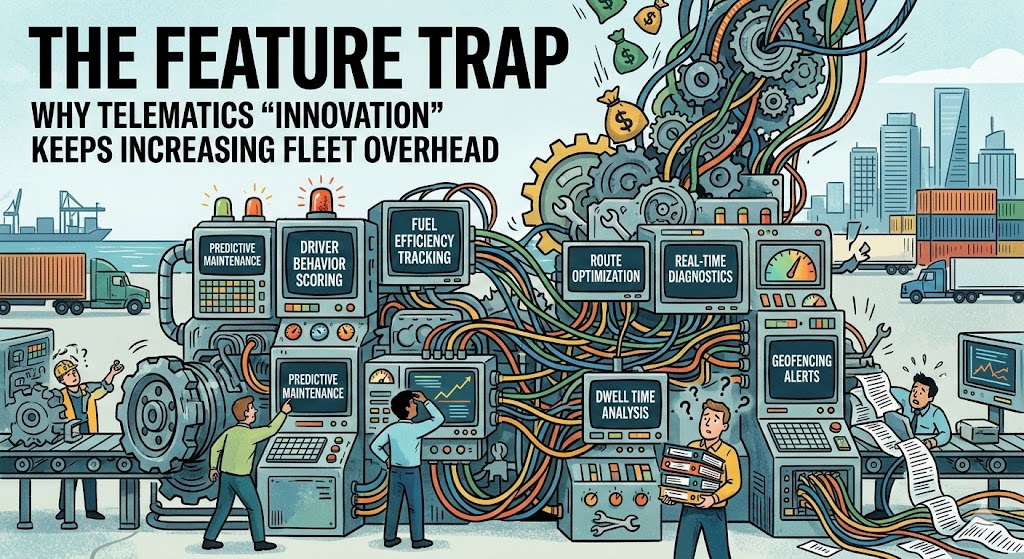
Fleet technology keeps shipping “more.”
More features.
More modules.
More dashboards.
More devices.
More rules.
More workflows.
And yet the lived experience inside many fleets is the opposite of progress: every new capability increases overhead. Someone has to install it, configure it, govern it, train the team, keep it current, manage exceptions, and defend the data when it disagrees with reality.
That’s the feature trap: capabilities that look like innovation in a demo but behave like operational weight in the real world.
Juxta’s view is simpler. Fleets don’t need an ever-expanding operations suite to get better outcomes. They need a stronger truth layer—one that makes tracking and analytics more reliable across real conditions without importing a bureaucracy to run it.
The overlooked cost center: “keeping the system true”
Most buying conversations focus on subscription price, device cost, and maybe installation time.
But the long-run cost is almost always somewhere else: the ongoing work required to keep the system accurate, trusted, and usable.
Overhead shows up in predictable places:
Configuration sprawl across sites and vehicle types.
Training and retraining as workflows proliferate.
Exception handling when reality doesn’t match the dashboard.
Internal program management just to keep adoption from decaying.
Data reconciliation when coverage gaps turn into disputes.
In other words, the system doesn’t merely report operations. It becomes a parallel operation.
That may be acceptable if you are consolidating everything into a single platform. But many fleets aren’t looking for an “operating system.” They’re looking for a technology layer that improves visibility and decision-making while fitting into the stack they already run.
Why “more features” often means “more fragility”
Here’s the uncomfortable pattern: the more complex a fleet platform becomes, the more fragile truth becomes.
Not because the engineering is bad, but because real fleets operate in environments that break assumptions:
Assets move indoors.
Vehicles transition through yards, docks, and covered staging areas.
Connectivity drops.
GPS degrades.
Work happens in dense industrial spaces where maps are a suggestion, not a reference.
When the underlying location layer is intermittent, every downstream feature inherits uncertainty. Safety analytics become debatable. Utilization gets distorted. Exceptions multiply. Users learn which screens to ignore.
So the organization responds the only way it can: by adding people, process, and program overhead to compensate for the gaps. That’s how technology intended to reduce work becomes a generator of work.
The breakthrough fleets actually need: a lighter truth layer
The next era of fleet intelligence isn’t about building the largest suite. It’s about reducing the cost of truth.
A lighter truth layer has three properties:
It is resilient in GPS-fragile conditions, not only in ideal conditions.
It reduces exception volume instead of creating new categories of exceptions.
It integrates into existing systems rather than demanding organizational re-platforming.
This is where Universal Positioning System (UPS) framing matters.
UPS treats positioning as a foundational layer that must remain reliable across environments—outdoors, indoors-adjacent, yards, dense industrial corridors, and dead zones—so the analytics built on top remain credible without requiring a massive operational program to keep them credible.
Where Juxta fits: technology that upgrades tracking & analytics without the platform tax
Juxta is a technology company, not a full operations tracking company.
We provide tracking and analytics, but we do it by focusing on the part of the stack that most determines whether the rest is trusted: location and movement integrity across real conditions.
That orientation has a strategic benefit for customers:
You don’t need to buy an operations empire to improve outcomes.
You don’t need to adopt a new bureaucracy to extract value.
You don’t need to replace the tools you already run your business on.
You upgrade the truth layer, and the stack you already have becomes more reliable.
A practical way to evaluate “overhead” before you buy
If you’re comparing solutions, don’t start with feature counts. Start with operational weight.
Ask three questions:
How much ongoing effort is required to keep the system accurate across sites?
What happens when GPS or connectivity degrades—does truth degrade with it?
How many features depend on users trusting the location layer implicitly?
Because in the end, the most expensive fleet technology isn’t the one with the highest subscription fee.
It’s the one that requires the most work to keep it true.
The new competitive axis: lower cost of truth
As platforms compete on breadth, fleets will increasingly compete on simplicity—specifically, how quickly they can turn movement into decision-grade insight without building a parallel organization to manage the tooling.
That’s what a lighter truth layer unlocks.
Not “more features.”
More confidence, with less overhead.
And that is the difference between technology that scales with your fleet and technology that scales your internal workload.
Next step
If you’re feeling the feature trap—more tools, more programs, more exceptions—start by identifying where truth breaks first: yards, depots, indoor-adjacent movement, and connectivity gaps.
Juxta helps organizations strengthen location integrity in those environments and turn it into tracking and analytics that fit into existing operations—without the platform tax.