
The Rising Cost of Fleet Risk Is a Location Integrity Problem
Fleet risk is usually discussed as a human problem. Coaching. Training. Compliance. Culture. Those matter, but they’re not the full system.
Juxta
Juxta Team
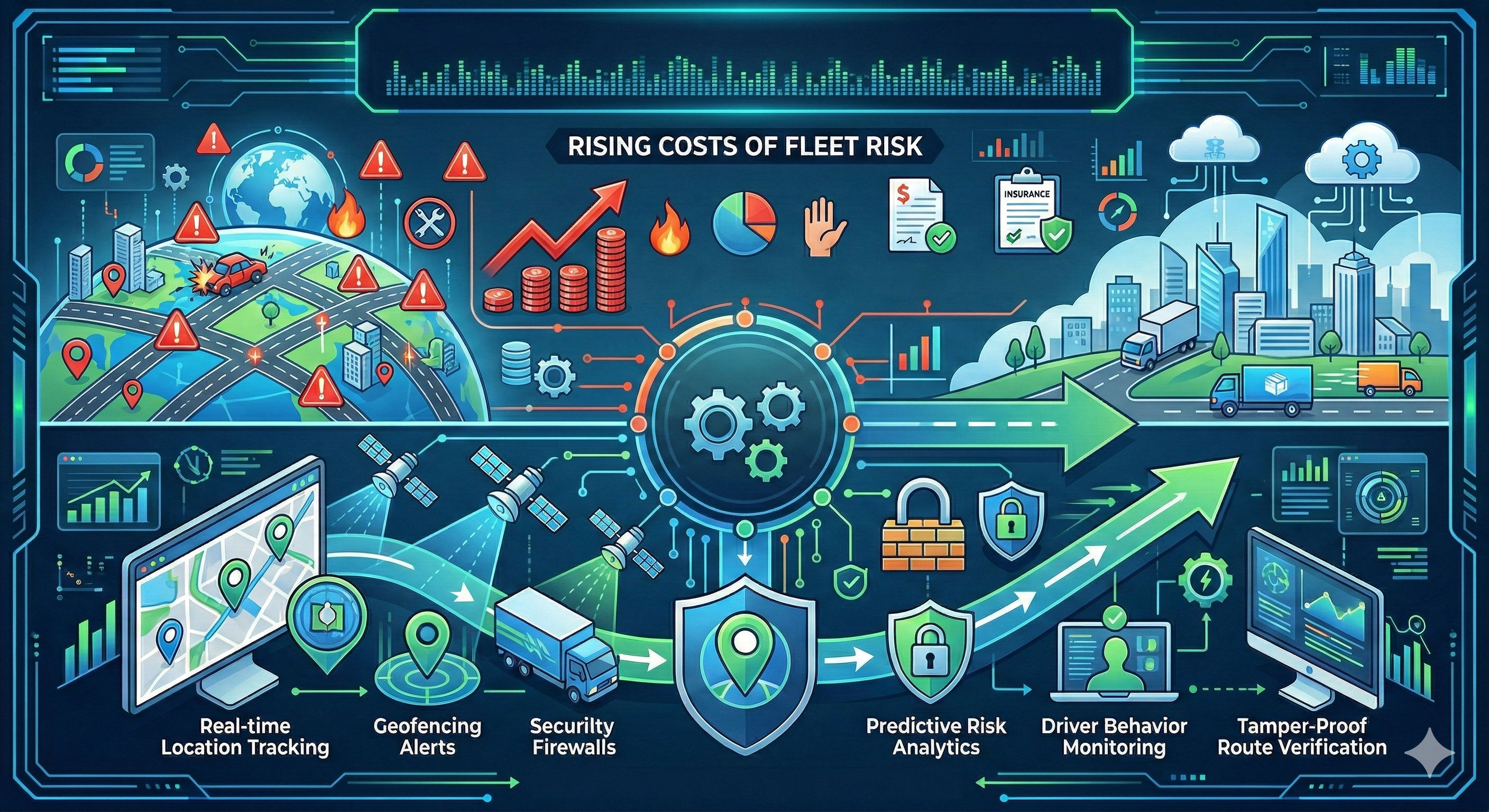
The most expensive risk events rarely come down to a single decision in a single moment. They come down to what happens when a fleet can’t establish truth fast enough: where a vehicle was, what route it took, whether it entered a restricted zone, whether it stopped where it claims it stopped, whether conditions changed, and whether the organization can reconstruct events without argument.
That’s why the rising cost of fleet risk is increasingly driven by a quieter dependency: risk is now priced by the integrity of your location layer.
When location integrity is weak, every incident becomes slower to resolve, harder to defend, more expensive to insure, and more painful to litigate. When location integrity is strong, risk compresses—because truth becomes faster to establish.
The modern risk stack is an evidence stack
In 2026, risk isn’t evaluated only by what happened. It’s evaluated by what you can prove.
The cost curve rises when evidence is incomplete, inconsistent, or ambiguous. That ambiguity creates downstream effects:
- Claims take longer and settle higher because disputes persist.
- Internal accountability erodes because teams can’t align on facts.
- Training becomes less effective because root causes are unclear.
- Compliance becomes fragile because exceptions can’t be audited reliably.
- Insurance leverage weakens because your data doesn’t hold up under scrutiny.
Most fleets blame this on “data quality” in general. The more accurate diagnosis is narrower:
when location truth is noisy, everything that depends on it becomes expensive.
Why “good enough GPS” creates expensive failure modes
Many tracking stacks were built under an assumption that location is a solved problem. Outdoors, most of the time, it is. That’s exactly why the failures are so costly: they happen in the places leadership least expects and operations feels most sharply.
Location integrity degrades in predictable environments:
- Dense industrial corridors and “metal canyon” yards
- Urban canyons and complex multi-level road networks
- Terminal transitions where indoor/outdoor boundaries blur
- Areas with intermittent connectivity or overloaded networks
- High-tempo operations where short gaps matter
When integrity degrades, systems often still report with confidence. That creates “map authority” without truth. And map authority without truth is a risk accelerant: it drives incorrect assumptions, bad decisions, and disputes that take weeks to unwind.
Location integrity: the part everyone forgets to buy
Most procurement conversations focus on features: alerts, workflows, dashboards, coaching modules. Those are downstream.
Location integrity is upstream. It is the foundation that determines whether every other capability functions in real conditions.
Integrity has three characteristics that matter operationally:
Continuity
Can you maintain a credible trajectory over time, not just isolated pings?
Confidence awareness
Does the system communicate uncertainty when conditions degrade, or does it quietly project certainty?
Auditability
Can you reconstruct what happened later with enough integrity to support claims, compliance, and internal reviews?
If any of these are weak, the fleet ends up doing risk management by conversation: calls, screenshots, disagreements, and ad hoc narratives.
Universal Positioning System (UPS): risk resilience without infrastructure dependency
Juxta defines a Universal Positioning System (UPS) as a positioning substrate that provides usable coordinates across environments without requiring fixed infrastructure to be deployed and maintained across every site.
UPS matters to fleet risk because risk does not occur only on open roads in ideal conditions. Risk clusters at edges: yards, terminals, dense urban corridors, and transitional zones where systems lose confidence.
UPS is built to change the economics of risk by changing the economics of truth:
- Location continuity that holds up when conditions are hostile
- Drift-minimized trajectories that remain coherent over time
- On-device inference that preserves usable truth even when networks degrade
This isn’t a tactical improvement. It’s a structural shift: risk becomes cheaper when truth becomes stable.
The executive shift: from “incident response” to “truth response”
Most organizations treat incidents as the core unit of risk management. In modern fleets, the true unit is the truth response cycle:
- Detect what happened
- Establish where and when it happened
- Confirm the sequence of events
- Decide responsibility and remediation
- Close the loop with training, policy, and procurement
When location integrity is weak, this cycle expands. When location integrity is strong, it compresses.
That compression is where ROI actually lives. Not in prettier maps. In fewer hours lost to dispute, fewer escalations, fewer repeat events, and faster resolution.
A risk leader’s evaluation rubric
If you’re a COO, safety leader, or risk officer evaluating tracking systems, avoid feature checklists. Ask the questions that reveal whether the system produces defendable truth.
1) Does the system admit uncertainty?
A system that never shows doubt trains your organization to trust it blindly. In risk, blind trust is expensive.
2) What happens at the edges: yards, terminals, dense corridors?
Most incidents become disputes at the edges, not the highway.
3) Can you reconstruct events without relying on narrative?
If the “truth” depends on who remembers what, you don’t have risk control. You have risk storytelling.
4) Is the system resilient to degraded connectivity?
If your tracking layer collapses under network strain, it will fail during incidents when everyone is trying to use it at once.
5) Does it reduce the time-to-resolution of disputes?
The most meaningful KPI is how quickly you can establish facts and close a case.
These questions are uncomfortable for legacy approaches because they expose the dependency model.
That’s the point.
The new standard: risk is priced by integrity
The rising cost of fleet risk is not just about more accidents, more regulation, or more litigation. It’s about the increasing premium placed on evidence quality and operational truth.
In this next era, the fleets that win will not be the ones with the most data. They will be the ones with the most reliable truth in the hardest places to measure.
That is what UPS is designed to provide: a universal positioning substrate that preserves continuity, confidence, and auditability when conventional assumptions break.
Because in modern risk, the most valuable capability is not avoiding every incident.
It’s being able to establish the truth quickly when one happens.