
Trailer Tracking Without Infrastructure
Visibility in yards, terminals, and metal canyons
Juxta
Juxta Team
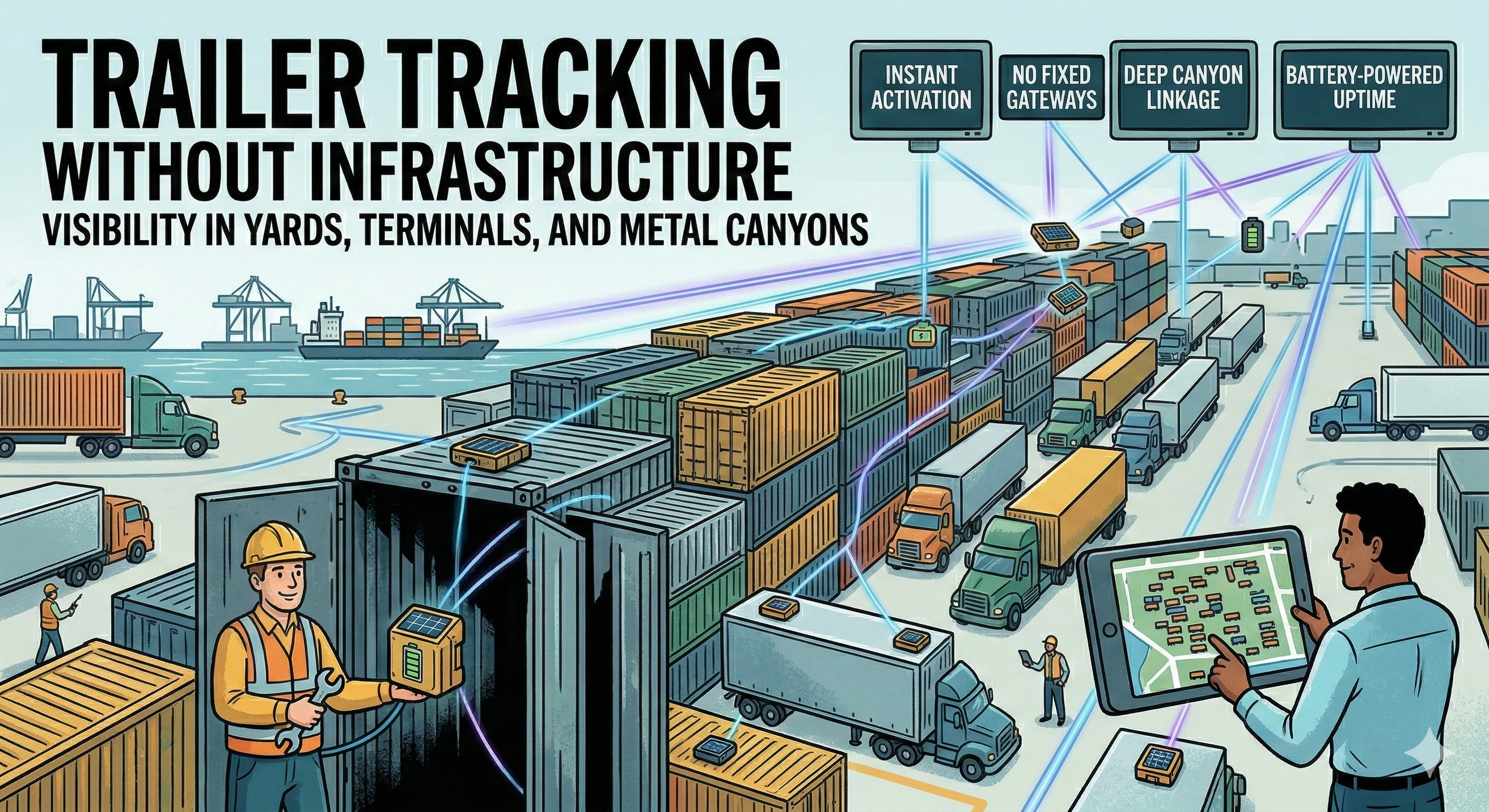
Trailer visibility is the easiest promise in logistics to make and the hardest to deliver. Not because fleets lack data, but because most tracking systems inherit assumptions that break exactly where trailers spend their most operationally expensive time: dense yards, terminals, staging lanes, dock-adjacent corridors, and the “metal canyon” geometry created by stacked equipment and buildings.
If your trailer tracking strategy depends on clean satellite reception, predictable network conditions, or a perfect handoff between “outdoor GPS” and “indoor systems,” the yard will expose it. And when the yard exposes it, the consequences show up as dwell inflation, mis-pulls, missed appointments, wasted labor hours, detention disputes, and a culture of workaround behaviors that become permanent.
This is the modern requirement: trailer tracking that remains continuous without infrastructure.
Not “more pings.”
Not “better dashboards.”
A location layer that holds up when the environment stops cooperating.
The yard is the truth serum for tracking systems
On-road location is forgiving. Routes are open, sky visibility is broader, and ambiguity often doesn’t matter minute-to-minute. Yards and terminals are the opposite. They compress time and space, multiply lookalike assets, and make “approximately here” operationally equivalent to “we don’t know.”
In a yard, the difference between row A and row C is not a rounding error. It is a forklift dispatch, a gate delay, a missed loading window, and a chain reaction that consumes labor and credibility.
Most fleets already know this, even if they don’t say it directly. You can see it in how operations teams talk:
- “The system says it’s on-site, but we still can’t find it.”
- “It’s showing near the yard, but that doesn’t help.”
- “We’ll just walk it.”
- “Call the driver.”
- “Check the last known.”
Those phrases are symptoms of the same issue: the tracking layer is not designed for constrained, occluded environments where truth must be granular enough to act on.
Why “last known location” is not operational visibility
Many platforms can tell you where a trailer was. Fewer can tell you where it is now in the conditions that matter most. “Last known location” is a comforting narrative that hides a deeper failure mode: when location confidence degrades, systems often keep reporting with false certainty.
That false certainty is worse than no data. It sends people to the wrong place, wastes labor, and creates disputes between teams because everyone’s working off a map that looks authoritative but isn’t actionable.
Operational visibility has a different definition:
Visibility is the ability to make a decision now.
Not later. Not after a refresh. Not after calling someone. Now.
That’s what infrastructure-dependent tracking struggles to produce in the yard.
The hidden cost of infrastructure-dependent visibility
Infrastructure-heavy approaches have an obvious cost profile and a less obvious one.
The obvious costs include deployment, maintenance, calibration, and the operational burden of keeping site systems aligned with changing yard layouts.
The less obvious costs are strategic:
First, you inherit fragility. When the environment changes, your visibility changes with it.
Second, you inherit latency. When systems need handoffs, truth arrives too late.
Third, you inherit gaps. When coverage is incomplete, operations becomes guesswork.
Fourth, you inherit dependency. When networks degrade, truth becomes optional.
Trailers do not wait for ideal conditions. Neither can your tracking layer.
What continuity actually looks like for trailers
The goal isn’t perfect precision everywhere. The goal is continuity you can trust across the entire operational loop:
- Arrival and yard entry
- Drop, staging, and dwell
- Gate moves and internal repositioning
- Dock assignment and loading readiness
- Departure and linehaul
- Terminal transitions and returns
Continuity is what turns location into execution. Without it, your team reverts to human search patterns, and the “tracking system” becomes a reporting system.
Universal Positioning System (UPS): location without infrastructure
Juxta defines a Universal Positioning System (UPS) as a location substrate that delivers usable coordinates across environments without requiring fixed infrastructure to be installed and maintained at every site.
UPS matters for trailer tracking because it addresses the core mismatch in legacy approaches: trailers spend a meaningful share of their lifecycle in places where GPS confidence is lowest and infrastructure is most expensive to deploy at scale.
The strategic shift is simple:
Stop treating the yard as an exception.
Treat the yard as the primary design constraint.
When your positioning layer is built for constrained environments, road tracking becomes the easy part—not the only part.
A buyer’s evaluation rubric for trailer tracking in 2026
If you’re evaluating systems, avoid getting trapped in feature lists. Trailer visibility is not a feature problem. It’s a location truth problem. Use questions that expose the dependency model.
1) Does it work when the yard geometry is hostile?
If a solution needs ideal sky view or stable conditions to be trustworthy, it will degrade right where you pay the most for uncertainty.
2) Does it remain credible when connectivity degrades?
A modern trailer visibility layer cannot assume continuous cellular reliability, especially in terminals, dense industrial areas, and boundary zones.
3) Does it reduce labor, not just report activity?
If you still need yard walks, calls, or manual confirmation loops, you have instrumentation—not visibility.
4) Does it scale without site-by-site projects?
The fastest way to fail at trailer visibility is to turn every yard into its own engineering program.
5) Can it support auditability and dispute resolution?
Visibility isn’t just real-time. It’s also the ability to reconstruct truth later with confidence, especially for detention, service-level disputes, and internal accountability.
If you can’t answer these with clarity, you’re buying a map—not an operating layer.
The operational outcomes that matter
When trailer tracking is continuous without infrastructure, the wins show up in the places fleets feel immediately:
- Faster trailer retrieval because search becomes execution.
- Lower dwell and detention exposure because truth is shared.
- Higher dock utilization because readiness becomes measurable.
- Fewer exceptions because ambiguity stops creating chaos.
These are not dashboard wins. They are throughput wins.
The new standard: continuity over comfort
A trailer tracking strategy that performs well only on open roads is a partial solution to a full-lifecycle problem. The yard, terminal, and metal canyon environments are not edge cases. They are the proving ground.
The next era of fleet and asset intelligence will be defined by systems that deliver universal, infrastructure-free continuity—the ability to maintain usable location truth even when GPS confidence drops and networks become unreliable.
That is what UPS is designed to make possible.