Healthcare organizations have spent the past decade investing in digital transformation. Electronic health records, mobile clinical applications, secure communications, and connected medical devices have become standard across much of the industry.
Today, clinicians carry smartphones or rugged handhelds throughout their shifts. Environmental services teams use mobile applications to manage room turnover. Patient transport staff rely on connected devices to receive assignments. Security officers, facilities personnel, and biomedical engineering teams all use mobile technology to coordinate daily operations.
Yet while these devices have become essential to hospital workflows, most of them still operate without one important capability: understanding where they are inside the hospital.
Juxta's software platform was built to change that.
Rather than requiring hospitals to deploy new tracking hardware or install positioning infrastructure throughout their facilities, Juxta integrates directly into existing mobile devices through a lightweight Software Development Kit (SDK), turning smartphones, tablets, rugged handhelds, and other IMU-equipped devices into a continuous source of indoor location intelligence.
The result is greater operational visibility using technology healthcare organizations already own.
Building on Existing Clinical Workflows
Hospitals have no shortage of connected devices.
A typical health system may already deploy:
- Clinical smartphones
- Secure communication devices
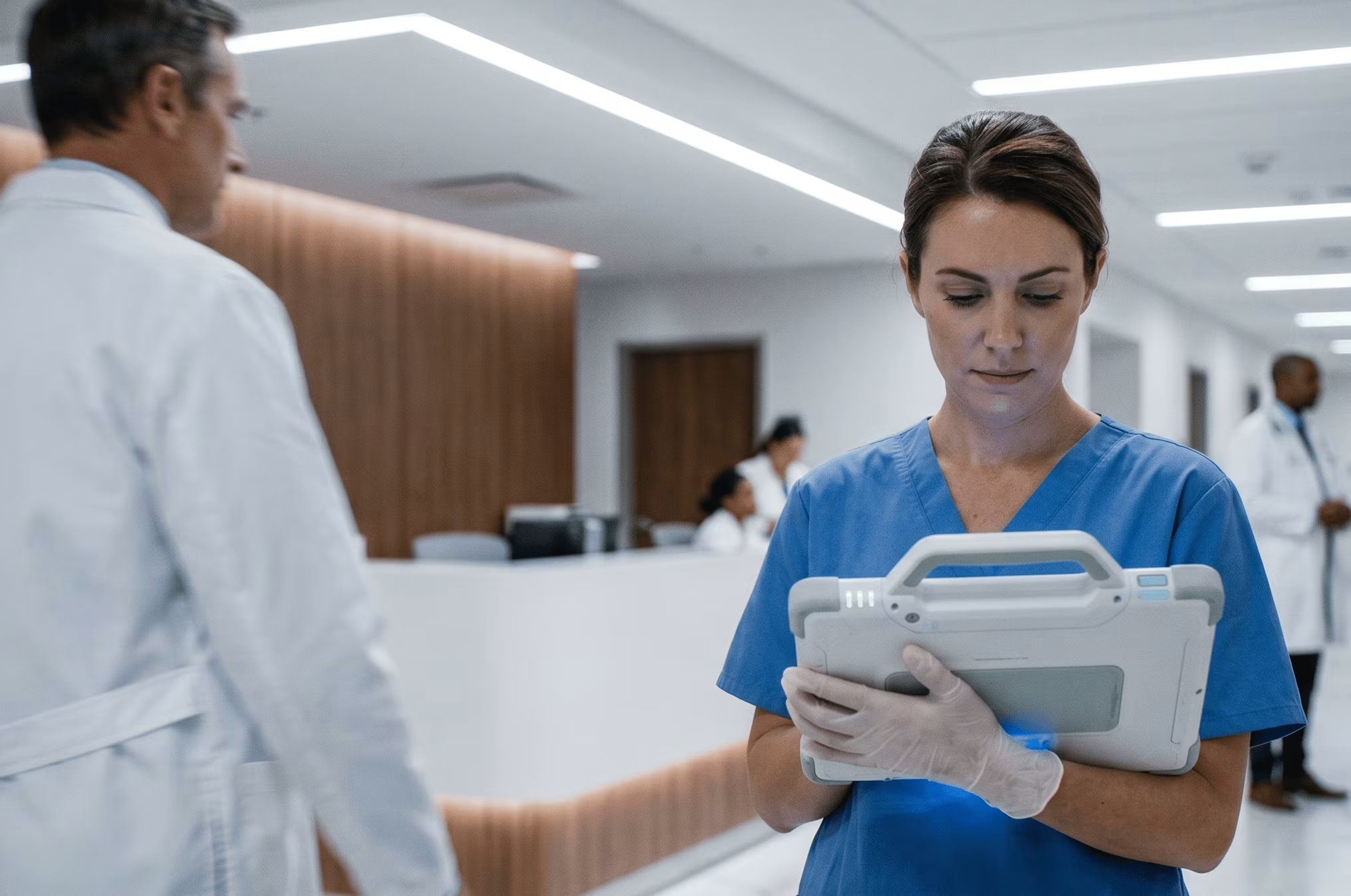
- Rugged Android handhelds
- Tablets used for patient care
- Patient transport devices
- Environmental services devices
- Facilities and maintenance handhelds
- Security team smartphones
- Biomedical engineering devices
These devices already support messaging, work orders, barcode scanning, patient transport, and clinical communication. Nearly all of them also contain inertial measurement units (IMUs)—accelerometers and gyroscopes capable of measuring movement.
Juxta's SDK uses those existing sensors to provide continuous positioning throughout a healthcare facility, allowing organizations to add location awareness without changing how staff already work.
A Software-First Alternative
Traditional Real-Time Location Systems (RTLS) have delivered valuable capabilities for many hospitals, but they typically require dedicated infrastructure such as Bluetooth beacons, Ultra-Wideband anchors, RFID readers, or ceiling-mounted hardware distributed throughout the facility.
These deployments can require significant planning, installation, calibration, and ongoing maintenance, particularly as hospitals renovate departments or expand campuses.
Juxta takes a software-first approach.
By combining sensor fusion with proprietary machine learning algorithms, the platform determines location directly from devices clinicians already carry, eliminating the need to install positioning hardware throughout the building.
For healthcare IT teams, deployment looks much more like adding a new software capability than implementing a new infrastructure project.
Understanding How Care Is Delivered
Healthcare organizations measure an enormous number of operational metrics.
Patient throughput.
Emergency department length of stay.
Room turnover.
Average transport time.
Nurse response times.
Equipment utilization.
Yet many of these metrics describe what happened without explaining why it happened.
Location data adds that missing operational context.
When integrated into existing clinical devices, Juxta provides a continuous picture of how staff move throughout a hospital, making it possible to understand how workflows function in practice rather than relying solely on operational reports.
For example, if patient transport times begin increasing, movement data may show that transport staff are walking substantially farther following a departmental renovation. If room turnover slows, administrators may discover that environmental services personnel are covering larger geographic areas than originally planned.
Instead of relying on assumptions, hospitals can make operational decisions using objective movement data.
Supporting Clinical Staff Without Changing Their Workflow
One of the advantages of software-based positioning is that clinicians do not need to carry additional devices.
Nurses continue using the smartphones they already rely on for secure messaging and clinical communication.
Transport personnel continue using their handheld devices.
Facilities teams continue using mobile work order applications.
Juxta simply adds location awareness to those existing devices.
That positioning data can help hospitals better understand:
- Staff travel distance
- Time spent moving between departments
- Response times
- Coverage across large facilities
- Workflow bottlenecks
- Department congestion
- Historical movement patterns
The objective is not to monitor individual employees. It is to understand how hospital operations function so that workflows, staffing, and facility design can be continuously improved.
Improving Patient Transport
Patient transport is one of the most movement-intensive functions within a hospital.
Transport teams move continuously between inpatient units, imaging departments, operating rooms, emergency departments, and discharge areas.
Even small inefficiencies accumulate throughout the day.
By integrating Juxta into existing transport devices, hospitals can better understand travel routes, average transport times, recurring delays, and movement between departments.
These insights allow administrators to identify bottlenecks, evaluate staffing strategies, and improve patient flow without introducing additional hardware into daily operations.
Enhancing Environmental Services
Environmental services teams play a critical role in patient throughput.
The speed at which patient rooms are cleaned and prepared directly affects admissions, transfers, and emergency department capacity.
Using existing mobile devices, Juxta provides visibility into movement throughout the facility, helping organizations better understand travel patterns, response times, and workload distribution across environmental services teams.
Rather than relying solely on room completion timestamps, hospitals gain insight into the operational factors that influence room turnover.
Supporting Security and Facilities Operations
Hospital security officers, facilities teams, and maintenance personnel spend much of their day moving between buildings, departments, and service requests.
Location intelligence can improve operational coordination by helping supervisors understand personnel distribution across a campus, identify the closest available responder, and analyze historical response times.
Whether responding to a facilities issue, security incident, or urgent maintenance request, location awareness provides additional operational context that supports faster decision-making.
Turning Movement Into Operational Intelligence
Perhaps the greatest value of software-defined positioning is the operational data it creates over time.
Across weeks and months, movement patterns begin to reveal opportunities for improvement.
Hospitals may discover that certain departments consistently require longer travel distances than expected.
They may identify congestion around elevators during shift changes.
They may find that specific patient transport routes create unnecessary delays because of facility layout rather than staffing shortages.
These insights are difficult to obtain through manual observation alone, particularly across large campuses operating twenty-four hours a day.
Continuous movement data makes them measurable.
Integrating Into Existing Healthcare Systems
Juxta is designed to become part of the existing healthcare technology ecosystem rather than operate as a standalone application.
The SDK can be integrated into:
- Clinical mobile applications
- Patient transport platforms
- Workforce management software
- Hospital operations dashboards
- Nurse communication systems
- CMMS platforms
- Business intelligence tools
- Custom hospital applications
By adding location context to existing workflows, healthcare organizations gain a more complete understanding of operational performance without replacing software already in use.
A Platform That Scales Across the Health System
Healthcare organizations rarely operate from a single building.
They manage hospitals, outpatient clinics, ambulatory surgery centers, rehabilitation facilities, administrative offices, and specialty care locations.
Because Juxta operates through software integrated into existing devices, expanding across additional facilities is significantly simpler than deploying dedicated positioning infrastructure at every site.
The same SDK can support consistent location services across an entire health system while leveraging the mobile devices staff already carry every day.
Healthcare organizations have already invested heavily in mobile technology. The opportunity now is to make those devices more valuable.
By integrating directly into smartphones, tablets, rugged handhelds, and other IMU-equipped clinical devices, Juxta enables hospitals to add real-time indoor positioning without introducing new tracking hardware or facility-wide positioning infrastructure.
More importantly, it provides something hospitals have historically struggled to measure: a continuous understanding of how people move through the physical environment where care is delivered.
That insight helps healthcare leaders identify operational inefficiencies, improve patient flow, optimize staffing, and make better decisions using the technology already in their hands.